The Earth-Shattering Story of Judith Barsi: Ducky Land Before Time Actress & Legacy
Quick Facts
🦖 The Land Before Time — Production & Legacy (Infographic)
This timeline highlights the creation of The Land Before Time (1988)—from early development through its lasting legacy—and includes a respectful note on the tragic death of voice actress Judith Barsi (Ducky).
- Mid-1980s — Conception 💡: Don Bluth partners with executive producers Steven Spielberg and George Lucas on a prehistoric adventure about young dinosaurs seeking the Great Valley.
- 1987 — Voice Casting 🎙️: Young talents are cast, including Gabriel Damon (Littlefoot), Candace Hutson (Cera), Will Ryan (Petrie), and Judith Barsi as Ducky.
- 1987–1988 — Production 🖌️: Animation and scoring progress under Don Bluth’s direction, with music composed by James Horner.
- July 25, 1988 — Judith Barsi 🕊️: Judith Barsi, the 10-year-old actress who voiced Ducky, dies tragically in a murder-suicide perpetrated by her father. Her work on the film had already been completed.
- November 18, 1988 — Theatrical Release 🎬: The Land Before Time premieres in U.S. theaters and becomes a box-office success.
- 1989 — Posthumous Dedication 🌟: Judith Barsi’s subsequent Don Bluth film, All Dogs Go to Heaven (1989), is released posthumously and dedicated to her memory.
- 1994–2007 — Home-Video Sequels 📼: The franchise expands with numerous direct-to-video sequels, introducing new songs and characters for younger audiences.
- 2007 — TV Series 📺: A television adaptation brings Littlefoot and friends to a new generation.
- Today — Enduring Impact 🌈: The original film remains beloved for its hand-drawn animation, James Horner’s score, and themes of friendship and perseverance—while Ducky’s “Yep, yep, yep!” lives on in pop culture.
💔 The Tragic Story of Judith Barsi — The Ducky Land Before Time Actress
The Tragic Story of Judith Barsi: The Voice Behind Ducky’s Eternal Optimism
Judith Eva Barsi’s story represents one of Hollywood’s most heartbreaking tragedies—a talented child actress whose bright voice brought joy to millions while she suffered unimaginable abuse behind closed doors. Best known as the voice of Ducky in “The Land Before Time,” Judith’s cheerful “Yep! Yep! Yep!” became an iconic phrase in animation history. Yet beneath her professional success lay a darker reality of domestic violence that would ultimately claim her life at just ten years old. Her murder on July 25, 1988, shocked the entertainment industry and highlighted the urgent need for better protection of child actors. This comprehensive examination explores Judith’s remarkable career, the warning signs that were tragically ignored, and the lasting legacy of a talent taken far too soon.
Early Life and Family Background
Judith Eva Barsi was born on June 6, 1978, in Los Angeles, California, to József Barsi and Maria Virovacz, both Hungarian immigrants who had fled their homeland during the 1956 Hungarian Revolution. The parallels between her parents’ backgrounds were eerily prophetic—both József and Maria had experienced neglectful and abusive childhoods in Hungary, a pattern that would tragically repeat in their own family.
József initially found work as a plumber after arriving in the United States, providing modest stability for the young family. However, by 1983, when Judith was only five years old, József’s drinking problem had become severe enough to impact his employment. His alcoholism led to frequent absences from work, ultimately resulting in his termination. The controlling nature that would later prove fatal was evident early on—József refused to allow Maria to work, leaving the family dependent on welfare during his periods of unemployment.[2]
Maria, recognizing her daughter’s natural charisma and talent, began to see acting as a potential path out of their financial struggles. Judith’s discovery at a San Fernando Valley ice skating rink at age five was almost serendipitous—talent agents mistook the petite child for a three-year-old, leading to her first opportunities in television commercials. This small stature would become one of Judith’s defining characteristics as a performer, often allowing her to play characters younger than her actual age.[3][2]
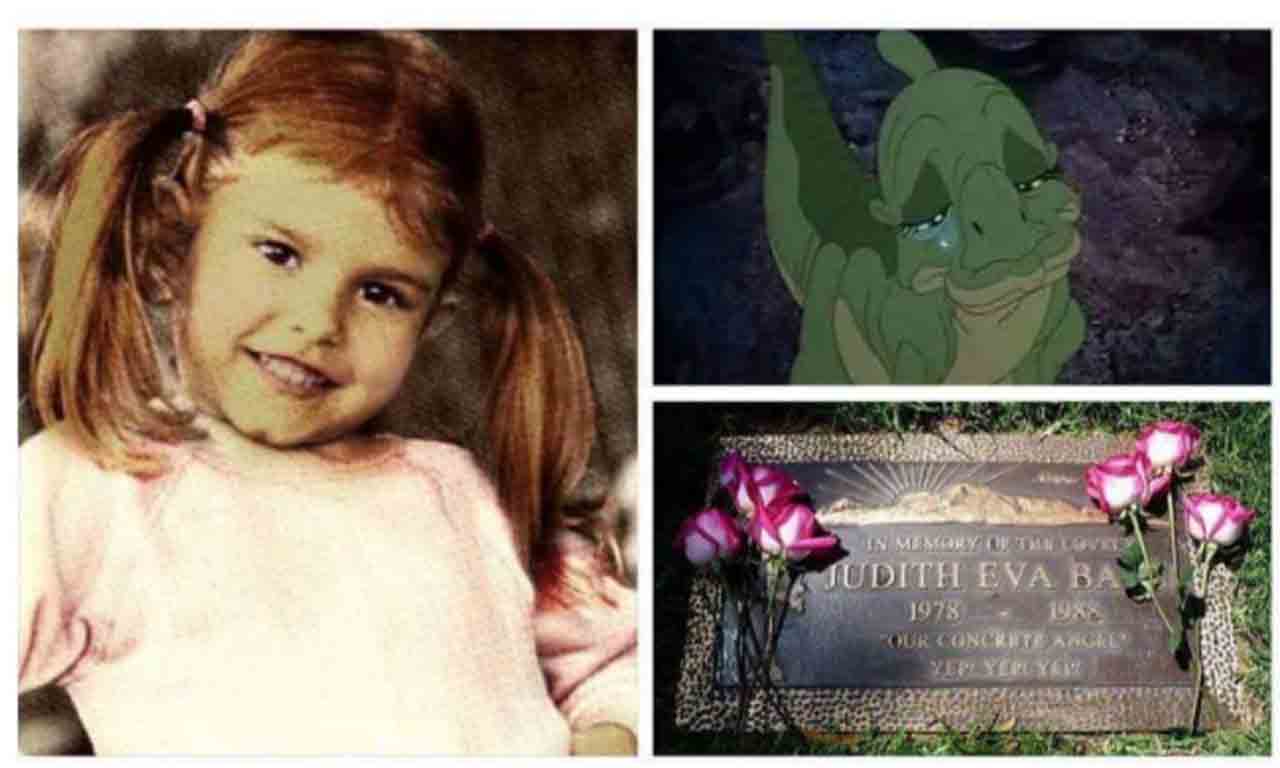
Judith Barsi’s grave memorial at Forest Lawn Hollywood Hills, inscribed with her years of birth and death and her iconic catchphrase from The Land Before Time.

Discovery and Rise to Stardom
Judith’s entry into the entertainment industry was remarkably swift and successful. After her discovery at the ice rink, she quickly demonstrated a natural aptitude for performance that set her apart from other child actors. Her first professional role came in 1984 with the television miniseries “Fatal Vision,” marking the beginning of what would become an extraordinarily productive but tragically brief career.
The young actress’s work ethic and professionalism impressed industry veterans from the start. Colleagues consistently described her as mature beyond her years, “down to earth,” and exceptionally professional on set. This maturity, while beneficial for her career, may have also been a coping mechanism developed in response to the chaos at home—a common trait among children from abusive households.
By the time Judith entered fourth grade, her earning potential had become extraordinary for someone so young. She was generating an estimated $100,000 per year through her various acting projects, making her the primary breadwinner for the Barsi family. This financial success allowed her parents to purchase a four-bedroom home in the West Hills section of Los Angeles, but it also created a dynamic that would prove increasingly dangerous as József’s resentment and control issues intensified.
Television and Commercial Success
Judith’s television career encompassed an impressive range of appearances across popular shows of the 1980s. Her filmography includes notable guest appearances on “Cheers,” “The Twilight Zone,” “Punky Brewster,” “Cagney & Lacey,” “Growing Pains,” and “The Tracey Ullman Show”. Each role demonstrated her versatility and natural screen presence, qualities that made her increasingly sought after by casting directors.
Her commercial work was equally prolific, with appearances in over 70 advertisements spanning various products and brands. These commercials not only provided steady income but also kept her visible in the industry, leading to more substantial television and film opportunities. The commercial work also allowed her to develop her craft in shorter formats, honing the timing and expressiveness that would serve her well in more complex roles.
Judith’s transition to feature films began with “Eye of the Tiger” in 1986, followed by her role as Thea Brody in “Jaws: The Revenge” (1987). While neither film was a critical success, they provided valuable experience in feature-length productions and established her credibility as a young actress capable of handling substantial roles.
Judith Barsi in a scene from “Jaws: The Revenge” (1987), highlighting her early live-action acting career.

The Voice Acting Career That Defined Her Legacy
While Judith’s live-action work demonstrated her range as a performer, it was her venture into voice acting that would cement her place in entertainment history. The transition to voice work allowed her to channel her expressive vocal qualities in new ways, creating characters that would resonate with audiences long after her death.
Her first major voice role came as Ducky in “The Land Before Time” (1988), directed by Don Bluth and executive produced by Steven Spielberg and George Lucas. The film’s production was a significant undertaking, bringing together some of the most respected names in family entertainment. Judith’s casting as Ducky, the optimistic young Saurolophus, proved to be inspired—her natural enthusiasm and genuine warmth translated perfectly to the character’s personality.
The recording process for “The Land Before Time” took place during the height of the abuse at home, making her professional demeanor even more remarkable. Voice acting required her to convey emotion purely through vocal performance, a challenge that showcased her natural talent and emotional intelligence. Her delivery of Ducky’s signature phrase “Yep! Yep! Yep!” became instantly recognizable and beloved by audiences worldwide.
Following the success of “The Land Before Time,” Judith was cast as Anne-Marie in Don Bluth’s “All Dogs Go to Heaven”. This role, as the sweet orphan girl who could communicate with animals, allowed her to demonstrate even greater emotional range. The character’s vulnerability and resilience perhaps reflected aspects of Judith’s own experience, though the full extent of her home situation remained hidden from most of her professional colleagues.
Animated scene from “All Dogs Go to Heaven” depicting Anne-Marie alongside a friendly dog character, showcasing Judith Barsi’s voice acting work.

Working Relationships and Professional Life
Despite the turmoil in her personal life, Judith maintained exemplary professional relationships throughout her career. Directors and fellow actors consistently praised her work ethic, punctuality, and positive attitude on set. Her ability to compartmentalize the abuse she experienced at home and deliver consistently strong performances speaks to both her professionalism and the tragic necessity of maintaining appearances.
The voice acting community, in particular, noted her natural ability to bring characters to life through vocal performance alone. Working with legendary director Don Bluth and the prestigious production teams behind both “The Land Before Time” and “All Dogs Go to Heaven” provided her with exposure to the highest levels of animated filmmaking. These experiences not only enhanced her skills but also demonstrated her potential for a long and successful career in the entertainment industry.
Her final completed work was for the ABC Afterschool Special “A Family Again,” where she played the character Billie Foster. This production would later be dedicated to her memory, serving as a poignant reminder of her contributions to children’s programming and educational content.
Escalating Abuse and Warning Signs
While Judith’s career flourished, the situation at home deteriorated dramatically. József’s alcoholism intensified, and his behavior became increasingly erratic and violent. The abuse targeted both Maria and Judith, with József reportedly throwing kitchen implements at his daughter and threatening her with knives. These violent outbursts were particularly severe when he was drinking, creating an atmosphere of constant fear and unpredictability.
Despite the severity of the situation, Maria’s attempts to seek help were inconsistent and ultimately ineffective. In December 1986, when Judith was eight years old, Maria made her first formal police report against József, alleging physical abuse including punching and strangulation. However, when police arrived and found no physical evidence, Maria chose to drop the charges, telling officers to leave and that they would handle the situation themselves.
The psychological impact on Judith became increasingly evident to those outside the family. She developed trichotillomania, a condition characterized by compulsive hair-pulling, which is often associated with severe stress and trauma. Friends of the family reported that Judith would express fear about going home, saying things like “I’m afraid to go home. My daddy is miserable. My daddy is drunk every day, and I know he wants to kill my mother”.
József’s threats became more specific and terrifying over time. He would threaten to burn down the house with the entire family inside, and his paranoid behavior included opening and reading all of Maria’s mail before allowing her to see it. When Maria received news of a family member’s death in Hungary, József’s controlling behavior prevented her from properly grieving or maintaining connections with her extended family.
The Tragic Final Days
The events leading up to the murder revealed a family in crisis with limited options for escape. Maria had finally begun making concrete plans to leave József, intending to divorce him and move away with Judith. However, her preparations were too little, too late—József’s violence had escalated to a point where any attempt to leave would trigger his most dangerous impulses.[6]
On the night of July 25, 1988, József’s threats became reality. In a devastating act of domestic violence, he shot both Judith and Maria in their West Hills home. Judith, just ten years old, was killed while she slept, a final act of betrayal by the father who should have protected her. After committing these murders, József set the house on fire in an apparent attempt to destroy evidence before taking his own life.
The bodies were discovered on July 27, 1988, two days after the murders. The scene that investigators found told a story of long-term abuse culminating in an ultimate act of violence—a tragic pattern seen too often in cases of domestic violence where controlling partners resort to murder-suicide when faced with the prospect of losing control over their victims.[3]
The Aftermath and Industry Response

The murder-suicide shocked Hollywood and left a deep impact on those who had worked with Judith. Productions she had been involved with scrambled to process the loss. Don Bluth and his animation team were particularly devastated, as they had come to regard Judith as an integral part of their creative family. Her final performance as Anne-Marie in “All Dogs Go to Heaven” (1989) was released posthumously and dedicated to her memory, ensuring her voice would continue to touch audiences even after her passing.
ABC also honored her memory by dedicating the 1989 Afterschool Special “A Family Again” to her, a poignant gesture that acknowledged both her talent and the senselessness of her death. Industry professionals began to discuss more openly the need for better systems of protection for child actors, though real systemic changes were slow to emerge.
The entertainment press at the time covered the tragedy extensively, but often in sensationalized terms. Today, her story is increasingly framed within the context of domestic violence awareness, highlighting the failures of legal and social systems to protect vulnerable individuals. Judith’s case remains a tragic example of how even outward success and fame cannot shield victims from hidden abuse within the home.
Legacy of Judith Barsi
Though Judith’s life was tragically brief, her legacy endures through the characters she brought to life. Ducky from “The Land Before Time” remains a beloved figure for multiple generations of children, with Judith’s voice immortalized in the character’s signature expressions of joy and optimism. Anne-Marie continues to resonate as one of Don Bluth’s most tender and heartfelt characters, representing innocence and resilience.
Judith was laid to rest at Forest Lawn Memorial Park in Los Angeles, California. Her grave has become a place of pilgrimage for fans moved by her story, with visitors often leaving toy dinosaurs and other tokens of remembrance. This ongoing attention speaks to the enduring connection audiences feel with the characters she voiced and the sorrow at the circumstances of her death.
Her story has also become an important case study in discussions of domestic violence, child abuse, and the particular vulnerabilities of child actors. Advocacy organizations have cited her case in pushing for stronger protective measures and more vigilant responses to reports of abuse. The tragedy emphasizes the importance of taking threats seriously, providing real support for victims, and understanding the warning signs that were tragically missed in her case.
Conclusion
The story of Judith Barsi is both inspiring and heartbreaking. Inspiring because of the extraordinary talent and joy she brought to millions in her short life; heartbreaking because of the preventable violence that ended that life far too soon. Her legacy serves as a reminder of the resilience of the human spirit even under the darkest of circumstances, and the responsibility society has to protect its most vulnerable members.
Through her performances, Judith Barsi continues to live on, her voice echoing in the laughter of children discovering “The Land Before Time” for the first time, or in the emotional resonance of “All Dogs Go to Heaven”. While her story will always carry the weight of tragedy, it also carries the enduring power of art to outlast even the most painful of human circumstances.
“Yep! Yep! Yep!” — Ducky, The Land Before Time (Judith Barsi)
🎬 Other Roles Judith Barsi Was In
Beyond her unforgettable role as Ducky in The Land Before Time, Judith Barsi had a surprisingly wide-ranging career for such a young actress. She appeared in commercials, television shows, and films that showcased both her acting and voice talents.
- All Dogs Go to Heaven (1989) — Voiced Anne-Marie, her final role, released posthumously and dedicated to her memory.
- Jaws: The Revenge (1987) — Played Thea Brody, the granddaughter in the fourth installment of the famous shark franchise.
- Growing Pains (1985) — Guest starred as a young character in the popular family sitcom.
- Punky Brewster (1985) — Appeared in the hit NBC series about the spunky young girl and her foster dad.
- The Twilight Zone (1985 reboot) — Featured in the classic anthology show’s revival episodes.
- Cagney & Lacey (1986) — Guest starred in the Emmy-winning police drama.
- St. Elsewhere (1984–1988) — Appeared in episodes of the acclaimed hospital drama series.
- Dozens of commercials — Judith was in over 70 television commercials, including spots for Jif peanut butter and Toys “R” Us.
Though she was only ten when her life was tragically cut short, Judith had already built a resume that rivaled that of many adult actors. These roles highlighted her versatility, from heartfelt voice acting to memorable live-action performances.
🎬 The Land Before Time: A Timeless Animated Classic
The Land Before Time (1988) is an animated adventure film that became one of the most beloved children’s movies of all time. Directed by Don Bluth and executive produced by Steven Spielberg and George Lucas, this prehistoric tale follows a young dinosaur named Littlefoot, an orphaned Apatosaurus who embarks on a perilous journey to find the legendary Great Valley—a lush paradise where dinosaurs can live in safety.
Plot and Characters
After an earthquake separates Littlefoot from his herd and tragically kills his mother, the young longneck must navigate a dangerous world filled with predators and natural disasters. Along the way, he befriends four other displaced dinosaur children: Cera, the stubborn Triceratops; Ducky, the optimistic Saurolophus (voiced by Judith Barsi); Petrie, the timid Pteranodon; and Spike, the gentle Stegosaurus. Together, they overcome species prejudices and learn invaluable lessons about friendship, courage, and cooperation, all while being pursued by the fearsome Sharptooth (a Tyrannosaurus rex).
Production and Style
Produced by Amblin Entertainment and Sullivan Bluth Studios with a budget of $12.5 million, the filmmakers conducted extensive research, even visiting natural history museums, to craft authentic prehistoric landscapes. Released on November 18, 1988, the film opened at number one at the box office and ultimately grossed $84.4 million worldwide.
Distinct from the lighter Disney animations of the era, the film embraced a darker and more emotionally complex tone, tackling themes of death, loss, and survival. This bold approach resonated deeply with audiences and critics alike, solidifying it as Don Bluth’s second-highest-grossing animated feature.
Franchise and Legacy
The movie’s success led to a sprawling franchise of thirteen direct-to-video sequels, a television series, video games, and a wide range of merchandise—though none featured the original creative team of Bluth, Spielberg, or Lucas. Despite the expansions, the first film endures as the definitive chapter, remembered for its artistry, heartfelt storytelling, and timeless emotional impact.
Enduring Appeal
Decades later, The Land Before Time remains a generational touchstone, especially cherished by millennials who grew up with Littlefoot’s journey. Its message—that hope, family, and friendship can carry us through even the darkest times—continues to inspire both children and adults, making it one of the most enduring animated classics ever created.
🏆 Awards & Achievements — The Land Before Time
Film Recognition
- Young Artist Award (1989) — Nominated: Best Family Animation or Fantasy Motion Picture.
- Parents’ Choice Award — Recognized for excellence in children’s media and family entertainment.
- Motion Picture Box Office Achievement — Ranked among the top-grossing non-Disney animated features of the 1980s with $84.4 million worldwide.
Judith Barsi (Voice of Ducky)
- Honored posthumously for her beloved performance as Ducky, which became one of the most memorable voices in children’s animation.
- Her line, “Yep, yep, yep!”, remains a cultural touchstone, quoted by fans across generations.
Franchise Legacy
- 13 direct-to-video sequels — making it one of the longest-running animated franchises in history.
- Television series (2007–2008) — Expanded its reach to a new generation of children.
- Consistently ranked among “most nostalgic animated films” in fan and critics’ polls, cementing its status as a timeless classic.
💚 Philanthropy & Community Impact Related to The Land Before Time
Though The Land Before Time (1988) was primarily an animated feature for entertainment, its cultural resonance and franchise longevity had indirect philanthropic and community benefits.
- Educational Outreach — The film was frequently used in schools and libraries to spark interest in dinosaurs, prehistoric science, and discussions about friendship, cooperation, and loss, promoting social-emotional learning.
- Judith Barsi’s Legacy — After Judith’s tragic passing, her role as Ducky became a lasting point of remembrance in conversations about child welfare and domestic abuse awareness, indirectly supporting advocacy for stronger protections.
- Children’s Charities & Screenings — Throughout the late 1980s and 1990s, the film was screened at charity events and hospital programs, offering comfort and inspiration to children facing adversity.
- Franchise & Family Engagement — With 13 sequels and a television series, the franchise emphasized messages of empathy and resilience, values that aligned with many youth-focused non-profits and community organizations worldwide.
- Cultural Philanthropy — The enduring popularity of the film bolstered public interest in paleontology, contributing indirectly to museum attendance and donations to natural history institutions that showcased dinosaur exhibits.
While not tied to a direct charitable initiative at release, The Land Before Time became part of a broader cultural and educational ecosystem—its impact reaching into classrooms, community events, and advocacy work connected to the memory of Judith Barsi.
✨ Three Very Interesting Facts About the Production of The Land Before Time
🦕 Heavily Edited for Young Audiences: Don Bluth’s original cut was over 80 minutes long, but more than 19 minutes were removed at the request of Steven Spielberg and George Lucas, who felt the tone was too dark and frightening for children.
🎤 Judith Barsi’s Iconic Voice: Ducky’s famous catchphrase—“Yep, yep, yep!”—was improvised by child actress Judith Barsi. The line became one of the most beloved and enduring parts of the entire franchise.
🌍 Real Prehistoric Research: The filmmakers visited natural history museums and consulted paleontologists to design accurate prehistoric landscapes, blending scientific authenticity with emotional storytelling.
🔴 Gladiator & Marcus Nonius Macrinus — 25 Question Quiz
1) Who directed Gladiator (2000)?
- Steven Spielberg
- Ridley Scott
- James Cameron
- Peter Jackson
2) Which emperor is Maximus loyal to at the start of the film?
- Marcus Aurelius
- Julius Caesar
- Hadrian
- Augustus
3) Marcus Nonius Macrinus was born in which city/region?
- Rome
- Alexandria
- Brescia (Brixia), northern Italy
- Ephesus
4) Who played the emperor Commodus in Gladiator?
- Colin Farrell
- Jared Leto
- Christian Bale
- Joaquin Phoenix
5) In what year did Gladiator premiere in theaters?
- 1999
- 2000
- 2001
- 2002
6) As Proconsul in 170/171 AD, which province did Macrinus govern?
- Britannia
- Hispania
- Egypt
- Asia
7) Most of ancient Pannonia Superior lies in which modern country?
- France
- Austria
- Hungary
- Turkey
8) What honor did Macrinus receive in April–June 154 AD?
- Suffect consulship
- Praetorship
- Censorship
- Triumph
9) In the film, Maximus’s home is in which Roman province?
- Achaea
- Sicilia
- Gaul
- Hispania
10) Historically, which person is credited with killing Commodus?
- Spartacus
- Priscus
- Narcissus
- Flamma
11) Which major award did Russell Crowe win for Gladiator?
- Emmy (Lead Actor)
- BAFTA (Best Actor)
- Golden Globe (Best Actor)
- Academy Award (Best Actor)
12) Who composed the film’s score?
- John Williams
- Hans Zimmer & Lisa Gerrard
- Howard Shore
- James Horner
13) Where was Macrinus’s mausoleum discovered in 2008?
- Along the Via Flaminia, north of Rome
- Pompeii
- Ostia Antica
- Carthage
14) Approximately what was Gladiator’s production budget?
- $55 million
- $80 million
- $103 million
- $150 million
15) The film opens with a battle in which region?
- Germania
- Syria
- North Africa
- Bithynia
16) Which emperor reigned immediately before Marcus Aurelius?
- Trajan
- Nerva
- Hadrian
- Antoninus Pius
17) What position did Macrinus hold in Pannonia Inferior?
- Prefect
- Legate (Legatus)
- Tribune
- Centurion
18) Which line is famously spoken by Maximus?
- “Strength and honor.”
- “To the last man.”
- “What we do in life echoes in eternity.”
- “No mercy.”
19) What happened to Macrinus’s tomb site in 2012?
- It was reburied to preserve it
- It was moved into a museum
- It was destroyed by flooding
- It was relocated to the Vatican
20) Which painting inspired Ridley Scott’s visual tone for the arenas?
- The Gladiators — Jean-Léon Gérôme
- Pollice Verso — Jean-Léon Gérôme
- The Death of Caesar — Jean-Léon Gérôme
- Oath of the Horatii — Jacques-Louis David
21) Many Colosseum scenes were staged at Fort Ricasoli in which country?
- Italy
- Morocco
- Spain
- Malta
22) How many Academy Awards did Gladiator win?
- Three
- Four
- Five
- Six
23) Marcus Aurelius is most closely associated with which philosophical school?
- Epicureanism
- Platonism
- Skepticism
- Stoicism
24) Before his betrayal, what title best describes Maximus’s role?
- Commander of the Senate Guard
- Prefect of the Praetorian Guard
- General of the Armies of the North
- Urban Cohort Tribune
25) Which pair served as executive producers on Gladiator?
- Douglas Wick & David Franzoni
- Steven Spielberg & George Lucas
- Brian Grazer & Ron Howard
- Scott Rudin & Harvey Weinstein
Show Answer Key
- B – Ridley Scott
- A – Marcus Aurelius
- C – Brescia (Brixia), northern Italy
- D – Joaquin Phoenix
- B – 2000
- D – Asia
- C – Hungary
- A – Suffect consulship
- D – Hispania
- C – Narcissus
- D – Academy Award (Best Actor)
- B – Hans Zimmer & Lisa Gerrard
- A – Via Flaminia, north of Rome
- C – $103 million
- A – Germania
- D – Antoninus Pius
- B – Legate (Legatus)
- C – “What we do in life echoes in eternity.”
- A – It was reburied to preserve it
- B – Pollice Verso — Jean-Léon Gérôme
- D – Malta
- C – Five
- D – Stoicism
- C – General of the Armies of the North
- A – Douglas Wick & David Franzoni
Answer distribution: A × 6 · B × 5 · C × 6 · D × 8 (well-distributed across A–D).
❓ The Land Before Time (1988) — Frequently Asked Questions
🦕When was The Land Before Time released?
The movie premiered in U.S. theaters on November 18, 1988. It quickly became one of the decade’s most beloved animated films.
🎬Who directed the film?
Don Bluth directed the movie. It was executive produced by Steven Spielberg and George Lucas, who helped bring the prehistoric adventure to life.
🦖Who are the main characters?
The central character is Littlefoot, a young “longneck” (Apatosaurus). He is joined by Cera the stubborn Triceratops, Ducky the cheerful Saurolophus, Petrie the nervous Pteranodon, and Spike the gentle, wordless Stegosaurus.
💔Does Littlefoot’s mother really die?
Yes. Early in the film, Littlefoot’s mother is mortally wounded by a Sharptooth (T-Rex). This emotional moment became one of the most memorable and heartbreaking scenes in children’s animation.
🎶Who voiced Ducky?
Ducky was voiced by Judith Barsi, a talented child actress whose life was tragically cut short in 1988, making her performance especially poignant for fans.
📽️How successful was the movie at the box office?
Made for around $12.5 million, it grossed over $84 million worldwide, opening at #1 in U.S. theaters against stiff competition from Disney’s Oliver & Company.
🌱What is the Great Valley?
The Great Valley is the dinosaurs’ mythical safe haven—lush with vegetation and free of predators—symbolizing hope, survival, and the promise of family and friendship.
📀How many sequels were made?
The original film spawned 13 direct-to-video sequels, plus a 2007 TV series. However, none involved Spielberg, Lucas, or Bluth, and most were aimed at a younger audience.
🎨What made the animation stand out?
Don Bluth’s team created detailed prehistoric landscapes using hand-painted backgrounds inspired by real fossils and museum studies, giving the film a strikingly authentic look for the late 1980s.
⭐Why is it considered a classic?
Its blend of emotional depth, stunning visuals, and timeless themes of loss, perseverance, and friendship made it resonate with both children and adults, cementing it as a multi-generational favorite.
📚 Land Before Time Affiliate Picks


Disclosure: As an Amazon Associate I earn from qualifying purchases.
📚 References (APA)
Biographical
📄 IMDb. (n.d.). Judith Barsi – Biography. IMDb. https://www.imdb.com/name/nm0058279/
📄 Judith Eva Barsi. (n.d.). Biography. JudithEvaBarsi.yolasite.com. http://judithevabarsi.yolasite.com/Bio.php
📄 Wikipedia Contributors. (2023). Judith Barsi. In Wikipedia. https://en.wikipedia.org/wiki/Judith_Barsi
📄 Simple English Wikipedia. (2023). Judith Barsi. Wikimedia Foundation. https://simple.wikipedia.org/wiki/Judith_Barsi
📄 Famous Birthdays. (n.d.). Judith Barsi. FamousBirthdays.com. https://www.famousbirthdays.com/people/judith-barsi.html
News & Reports
📄 Los Angeles Times. (1988, July 28). Bodies identified as child actress, mother. Los Angeles Times Archives. https://www.latimes.com/archives/la-xpm-1988-07-28-me-9912-story.html
📄 Los Angeles Times. (1988, Aug 7). Panel scolds agency in girl’s death. Los Angeles Times Archives. https://www.latimes.com/archives/la-xpm-1988-08-07-me-382-story.html
📄 Los Angeles Times. (1988, Sept 7). Inquiry in Barsi case dropped too soon, panel says. Los Angeles Times Archives. https://www.latimes.com/archives/la-xpm-1988-09-07-me-1411-story.html
📄 New York Times. (1988, July 30). Child actress is slain, apparently by father. The New York Times. https://www.nytimes.com/1988/07/30/us/child-actress-is-slain-apparently-by-father.html
📄 People. (2023). Judith Barsi murder: What to know. People.com. https://people.com/judith-barsi-murder-what-to-know-8701466
Memorials & Archives
📄 Find a Grave. (n.d.). Judith Barsi (1978–1988). FindAGrave.com. https://www.findagrave.com/memorial/3038/judith-eva-barsi
📄 The Daily Jaws. (2020). The tragic death of JAWS: The Revenge child star Judith Barsi. TheDailyJaws.com. https://thedailyjaws.com/blog/a-talented-child-star-judith-barsi
📄 Don Bluth Wiki Contributors. (2023). Judith Barsi. Don Bluth Wiki – Fandom. https://donbluth.fandom.com/wiki/Judith_Barsi
True Crime & Cultural Retellings
📄 Far Out Magazine. (2022). The tragic story of the child star Judith Barsi. FarOutMagazine.co.uk. https://faroutmagazine.co.uk/tragic-story-child-star-judith-barsi
📄 All That’s Interesting. (2021). Inside Judith Barsi’s tragic death at the hands of her own father. AllThatsInteresting.com. https://allthatsinteresting.com/judith-barsi
📄 Cheat Sheet. (2020). ‘The Land Before Time’ child actor Judith Barsi’s gruesome murder. Showbiz Cheat Sheet. https://www.cheatsheet.com/entertainment/the-land-before-time-judith-barsi-murder.html
📄 Collider. (2022). The tragic true story behind ‘The Land Before Time’ star’s untimely death. Collider.com. https://collider.com/land-before-time-judith-barsi-true-story/
Video Documentaries
📺 Neale, E. (2023). The tragic murder of child star Judith Barsi [Video]. YouTube. https://www.youtube.com/watch?v=ILwq09TiNGE
📺 Kenny, E. (2023). Hollywood horror: Remembering Judith Barsi [Video]. YouTube. https://www.youtube.com/watch?v=Ti-ZRo4iXNo
📺 Juicy Pop Entertainment. (2023). The tragic death of rising child star Judith Barsi [Video]. YouTube. https://www.youtube.com/watch?v=94M9gbbGH_0
📺 Gavagan, R. (2021). The tragic death of Judith Barsi | Anatomy of Murder [Video]. YouTube. https://www.youtube.com/watch?v=cxU65St9T6w
Curious about weird movie facts? Explore our deep-dive feature.