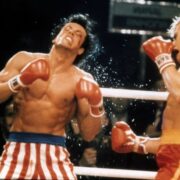
Rocky Steps Scene: Filmed Illegally With Tiny Crew
⚡ Quick Facts — Rocky (1976) Philadelphia Steps Run
- 🎬 Scene: Rocky’s early morning training run up the steps of the Philadelphia Museum of Art
- 🧠 Stallone’s Intent: Turn a small boxing story into a myth about one ordinary guy pushing past every limit
- 💰 Budget Reality: Shot on a low budget with a small crew, often without formal permits in Philadelphia
- 📍 Location: Philadelphia Museum of Art steps, now known worldwide as the “Rocky Steps”
- 🎥 Key Crew: Director John G. Avildsen, cinematographer James Crabe, Steadicam creator Garrett Brown
- ⚙️ Camera Tech: Filmed using one of the earliest Steadicam rigs, which let the camera float with Rocky as he ran
- 🐕 Butkus Fact: Stallone first tried to run the steps carrying his real dog, Butkus, then dropped the idea when his legs gave out halfway up
- 🚓 Permit Situation: The team rushed the shot and left fast because they were worried the police might stop them
- 🚐 Guerrilla Style: Much of the training montage was shot by chasing Stallone around Philly in a van with a tiny crew
- 🏛️ Later Legacy: The steps became a tourist landmark, a city symbol, and the namesake of Stallone’s memoir The Steps
- 🏅 Symbolism: The run up the steps became a visual shortcut for every underdog story told after it
🎬 Rocky (1976) — Philadelphia Steps Run Infographic
A broke actor, a new camera, and a staircase that turned into a life story.
No permit, tiny crew, fresh Steadicam rig, and one chance to outrun the day and maybe the cops.
1. How the steps run was built
- Broke but stubborn: Stallone refuses to sell the script without starring, even though he needs money badly.
- Guerrilla montage: Avildsen and a tiny crew chase Stallone through real Philly streets from a van.
- New tech: Steadicam creator Garrett Brown straps on his rig to glide up the steps with Rocky.
- Stolen moment: No permit for the museum steps, so they run, shoot, and leave before anyone stops them.
- Instant icon: One fast shot becomes the image printed on posters, T-shirts, and statues for decades.
2. What made this run different
📽️ Camera that moves like a person
Steadicam let the shot stay smooth while Brown ran, so we feel inside Rocky’s stride instead of watching from far away.
🏃 Real streets, real reactions
Vendors, kids, and traffic were not extras. They were just Philly watching some guy jog by with a camera chasing him.
🚓 Fear of getting caught
The stress of “get it before the cops come” adds real urgency to Stallone’s run and his punches in the air.
“Let me just run up the steps, get a shot, and we’ll get out of here.”
🏛️ A staircase turned into a shrine
Now fans run the same steps to feel like they are in the movie, not just watching it.
3. Why people keep watching this one run
It is not just cardio. It is Stallone’s whole career in one sprint.
- 🟣 It looks simple but was risky and rushed.
- 🟣 It feels like a documentary of a guy trying to change his life.
- 🟣 It is cheap filmmaking that looks expensive on screen.
- 🟣 It turned a local staircase into an international symbol.
4. How to use this in your internal link funnel
Common search phrases around this scene:
- 🔍 “Rocky steps behind the scenes”
- 🔍 “How did they film the Rocky run”
- 🔍 “Where are the Rocky steps”
- 🔍 “Garrett Brown Steadicam Rocky”
Drop internal links to your bigger Stallone or underdog-actress-actor pieces and keep readers inside your movie story universe.
🥊 Section 1 · The happy accident that became the heart of Rocky
One stolen run that turned into a legend
The Rocky shot at the top of the staircase is something everyone can relate to and everyone knows. That feeling of reaching the top, achieving the pinnacle, the music blasting, it’s a moment in history, and a smile that comes to everyone’s face. He throws up his arms up like he has already won the title. It is the image that sells the movie, the poster, the statue, and half of Philadelphia’s tourism.
What most people do not know is that the whole thing was basically a quick grab. No permit. No big plan. No idea that this little run would follow Sylvester Stallone for the rest of his life.
“Let me just run up the steps, get a shot, and we’ll get out of here before the police come.”
Sylvester Stallone
Stallone has told the story with a little grin. The crew was working with very little money. They did not have time to close down a museum or lock off a public area. They drove up, he jumped out of the car in his sweats, the camera rolled, and he sprinted up the stairs while the crew hoped no guard showed up to ask what they were doing.
His first idea was even wilder. He wanted to carry his dog Butkus, a huge bull mastiff, up the steps in his arms. It made sense in his head. Rocky and his only real friend climbing the steps together. In reality the dog was so heavy that sly stallone’s legs started to give out halfway up. They scrapped the idea and kept the human-only version.
“My dog is like a buffalo. I got halfway up and thought my knees were going to explode.”
Sylvester Stallone
That mix of out of the box ideas, very real limits, and no time is baked right into the scene. When you watch Rocky at the top of the steps, breathing hard and pounding his chest, you are also watching Stallone feel something in real time. This is his one shot, both in the story and in his actual career.
He was not just playing an underdog on screen. He was one. That is why the shot hits so hard. It is not pretty. It is not polished. It is a hungry actor racing a clock nobody else can see.
🎥 Section 2 · A million dollar movie shot like a student film
How a tiny crew and a van built the whole training run

Rocky did not have the kind of money people imagine when they hear “Oscar winning movie.” The budget was small, the schedule was tight, and a lot of the crew came from low budget and documentary work. Director John G. Avildsen knew he could not stage giant crowd scenes on real streets. He had to move fast, get what he could, and basically go.
So they treated large parts of the film like a student project. Stallone would dress in character, the crew would pile into a van with the camera in the back, and they would roll around Philadelphia looking for spots to use. See a good corner or market? Stop the van, hop out, grab a shot, and get back in before anyone had time to complain.
“We didn’t have permits. We didn’t have extras. We had a van, a camera, and a guy willing to run.”
John G. Avildsen
The famous Italian Market run is a perfect example. Stallone jogs past real vendors who were not paid background actors. Some wave, some ignore him, and one tosses him an orange. That toss was not in the script. It just happened. Stallone caught it without breaking stride and Avildsen kept it because it made the city feel alive and real.
For Stallone this kind of shooting matched his script. Rocky is a man who lives in the corners. He works in a beat up gym, collects money for a small time loan shark, and walks past people who barely notice him. Having him run through real streets with real people makes that world feel solid. It also mirrors Stallone’s own path, a mostly unknown actor moving through a city full of people who have no idea who he is.
“Rocky was never meant to look perfect. It was meant to look like the world I came from.”
Sylvester Stallone
The steps run is the peak of that whole approach. After seeing Rocky weave through alleys, docks, and markets, the museum steps suddenly feel like a wall he has to climb. He is still a nobody. But for a few seconds at the top, with a skyline behind him, he feels like more.
📽️ Section 3 · The strange new camera that chased him up the stairs
How Steadicam turned a jog into a myth

Before Rocky, cameras usually had only two speeds. They were either locked on a tripod and did not move, or they were on someone’s shoulder and bounced with every step. Then he met Garrett Brown, a Philadelphia native who started building this device in his garage that could balance or stabilize a camera on his body.
He filmed his own test reel around the city to show what this “Steadicam” could do. One of his early test shots was of someone running up the same art museum steps. The shot looked like the camera was gliding instead of bouncing. Hollywood execs saw the reel, and soon Brown and his rig were being hired for major movies.
“The Steadicam meant the camera could move like a person without making the audience seasick.”
Garrett Brown
When Rocky came along, Brown joined the production. He sat in the back of that van for some of the training shots. For others he ran alongside Stallone or in front of him, his rig easily adjusting to every bounce of the steps and sidewalks. In the boxing scenes he even stepped into the ring in a referee shirt so he could circle the fighters with the camera.
“If we had shot that run handheld, it would have just been a guy shaking up some stairs.”
James Crabe
With Steadicam, the camera can glide up behind Rocky as he pushes toward the top. It is close enough that you feel his breath, but smooth enough that your brain believes in the moment. That is a huge part of why the steps run feels bigger than it is. It is just one man running, but the camera treats him like he is already part of a legend.
🐕 Section 4 · Butkus, cops, and the takes that did not make it
The weird attempts that had to fail first

Fans love seeing Butkus in the film, because he was not a Hollywood dog, it was Stallone’s dog. He was Stallone’s real pet from a rough time in his life. So, it makes sense that the first silly idea on the steps was to bring Butkus along in the most dramatic way possible.
Stallone tried to run the staircase with Butkus in his arms. It sounded poetic, a man and his best friend conquering the world together. In practice the dog was huge. After a short climb his legs started shaking and the shot fell apart. They put Butkus back in the car and moved on.
“That was it for my dog’s acting career on stairs.”
Sylvester Stallone
The fear of getting shut down was real too. They did not have paperwork to film on those steps. The museum was not closed for them. Stallone and the crew were visitors like anyone else, except they had a camera and a film to finish. The plan was really simple. Run in, shoot as fast as possible, and hope no one with a badge decided to ask about permits.
“We figured if they chased us off at least we would have something on film.”
Sylvester Stallone
That pressure seeps into the moment. There is no big crowd of extras blocking the stairs. There are no police cars jammed into the background. Just a man, a staircase, and a camera operator hustling to keep up. The chaos behind the scenes gives the run a raw edge. It feels like one clean, unrepeatable moment because that is exactly what it was.
🏛️ Section 5 · From stolen shot to city landmark and RockyFest
How one fast run turned into a ritual

Today, the art museum steps are as famous as the Liberty Bell. People fly in from all over the world just to run up them, throw their hands in the air, and take a picture like the training montage. The city embraced the image so fully that the staircase is now simply called “the Rocky Steps.”
There is a Rocky statue at the base of the steps, and another cast of the statue has been placed at the top during special events. Philadelphia has hosted Rocky-themed festivals where fans gather for screenings, Q and A sessions, and group runs up the stairs. What began as a fast, unapproved shot is now part of the city brand.
“You can learn from watching Rocky to keep moving forward no matter what life throws at you.”
Rocky fan at a Philadelphia celebration
The sculpture artist behind the Rocky statue once said that real fighters like Joe Frazier are the facts of boxing history, while Rocky is the myth. The myth, however, is what people are lining up to take pictures with. That is the power of a single image that captures how it feels to keep going when you are tired, broke, and almost out of options.
“Rocky is that story, that inspiration people carry home with them.”
Rocky statue sculptor
None of this was written into the script. Stallone and the crew did not know they were making a future pilgrimage site for runners, boxers, and kids with big dreams. They were just trying to finish a movie. But that is what makes the whole thing feel so honest. A rushed decision in the seventies has turned into a physical place where almost anyone can go today and act out their own version of the underdog story.
📘 Section 6 · The hungry actor and the memoir named after a staircase
Why Stallone’s life now circles back to those steps

Before Rocky, Stallone was just another actor in New York and Los Angeles, trying to pay rent, take care of a family, and not give up. He wrote the script fast after seeing a real fight where an unknown boxer refused to fall down against a champion. He saw himself in that fighter. Too small on paper, but too stubborn in practice.
Studios liked his script but wanted a proven star to play the lead. They offered money if he would step aside. He turned it down, risking everything, because he believed this was the one part he could play in a way no one else could.
“I’d rather bury it in the backyard than sell it and watch somebody else do it.”
Sylvester Stallone
That is the headspace he was in when he ran those steps. This was not just another job. If the movie failed, he had no backup plan. His whole gamble was on this character, this story, and this city. The top of the staircase feels like a victory long before the title fight because, for him, just getting there was a victory.
Now he has a memoir called The Steps. The title is not subtle. He sees that run as a symbol for his life. A long climb from the bottom, with moments where your legs want to give up, and a simple choice to take one more step instead.
“You reach a point where you ask, am I going to win or is life going to win.”
Sylvester Stallone
The cool part is that the most famous shot of his career was never meant to be grand. It was fast and risky. That is exactly what makes it so honest. It is the purest version of what he was trying to do as a hungry actor. Not just play an underdog, but capture what it looks and feels like to bet everything on one last climb.
🥊 Rocky (1976) — The Steps & Filming Trivia
1) Why did the crew rush the Philadelphia steps shot?
- They had no filming permit and feared being stopped by police
- A thunderstorm was approaching fast
- The museum was closing in five minutes
- The camera batteries were dying
2) What camera invention made the scene possible?
- The Steadicam
- A handheld drone rig
- A shoulder dolly
- A rotating jib arm
3) Who invented and operated the Steadicam during the Rocky run?
- Garrett Brown
- John G. Avildsen
- James Crabe
- Sylvester Stallone
4) What animal did Stallone originally try to carry up the steps?
- His 130-pound bullmastiff, Butkus
- A large turkey for a holiday scene
- A stuffed boxing dummy
- A sack of training weights
5) What was the crew’s filming method during the training montage?
- They chased Stallone in a van, grabbing shots across real Philly streets
- They built an indoor treadmill set
- They filmed the run entirely on a green screen
- They used rear projection of the city skyline
6) What major Philadelphia location served as the finish line?
- The Philadelphia Museum of Art
- Independence Hall
- City Hall
- Boathouse Row
7) How did the filmmakers achieve smooth motion on a tiny budget?
- By testing Garrett Brown’s new Steadicam prototype
- By using a helicopter for aerial shots
- By renting studio tracking rails
- By shooting with slow-motion film
8) Which Philadelphia market appears in the montage where Rocky gets handed an orange?
- The Italian Market
- Reading Terminal Market
- Eastern State Market
- Broad Street Market
9) Who directed the original Rocky (1976)?
- John G. Avildsen
- Martin Scorsese
- Francis Ford Coppola
- Brian De Palma
10) What award did Rocky win that surprised Hollywood?
- Best Picture at the 1977 Academy Awards
- Best Documentary
- Best Visual Effects
- Best Costume Design
11) What real-life title does Stallone’s memoir share with the film’s most iconic scene?
- The Steps
- Going the Distance
- Eye of the Tiger
- Heavyweight
12) What symbol did the Philadelphia Museum of Art later add near the steps?
- A bronze statue of Rocky Balboa
- A marble plaque of Stallone’s handprints
- A boxing glove fountain
- A life-size cutout from the film poster
13) How did the public react to the statue when it was first placed?
- Some saw it as movie art, others as not “real art” for the museum
- It was instantly accepted by everyone
- It was rejected by Stallone himself
- It was removed for safety issues
14) What is the name of Philadelphia’s annual celebration honoring the film?
- RockyFest
- Philly Strong Marathon
- Balboa Days
- Eye of the Tiger Festival
15) Why do so many fans still climb the steps today?
- To re-create the training scene and feel like Rocky for a moment
- Because it’s required to enter the museum
- Because the city holds daily races there
- Because Stallone invites fans each weekend
📖 FAQ — Rocky’s Philadelphia Steps Run & How It Was Shot
Did they really not have a permit to film on the steps?
Accounts from Stallone and others say the production did not have a formal permit for that shot. They showed up with a small crew, filmed quickly, and left, hoping not to be stopped. It was classic guerrilla filmmaking.
Was the training run all shot in Philadelphia?
The wide city material, including the Italian Market and the steps run, was shot in Philadelphia. Other parts of the film were done in Los Angeles, but the key run that everyone remembers is real Philly pavement.
Who came up with the idea to use Steadicam?
Garrett Brown had already built and tested his Steadicam around Philadelphia. The Rocky team saw what it could do and brought him and his rig onto the movie. That is how the camera could glide with Rocky instead of shaking all over.
Were the people in the background hired extras?
In many shots they were not. They were real vendors, shoppers, and locals who happened to be there when Stallone jogged past. That is why some wave, some ignore him, and some interact naturally, like the vendor who tosses him an orange.
Why is this scene such a big deal if it is just running?
Because it is simple but honest. You can see a man push past his own limits, in a real city, with a real camera chasing him. It sums up the whole movie. A nobody working his way toward one chance at something bigger.
Is the Rocky statue original to the movie?
The statue was created for a later film in the series but was given to the city. It now stands near the steps and has become part of the experience for fans who visit and reenact the run.
Why did Stallone name his memoir “The Steps”?
For him, those steps represent the climb from nothing to something. It is not just a location. It is a symbol of every choice he made to keep going, even when people told him to sell the script and move on.
What’s the best clip to show the full impact of the scene?
The full training montage ending at the steps works best. Pair it with behind the scenes interviews where Stallone talks about the run, and with footage of modern fans charging up the “Rocky Steps” for their own victory pose.
🛒 Rocky Gear & Books (Amazon)


Disclosure: As an Amazon Associate I earn from qualifying purchases.
📚 Rocky (1976) — Steps Run, Steadicam Work, and Stallone’s Story (APA)
Film & Production Commentary
📄 Avildsen, J. G. (Director). (1976). Rocky [Film]. United Artists.
📄 Avildsen, J. G. (2006). Rocky: Audio commentary [DVD commentary track]. MGM Home Entertainment.
📄 Stallone, S. (2006). Rocky: 30th anniversary featurettes [DVD interviews]. MGM Home Entertainment.
Steadicam & Camera Technology
📄 Brown, G. (2005). Steadicam and Rocky: Inventing a new way to move. In American Cinematographer archives. American Society of Cinematographers.
📄 American Society of Cinematographers. (2006). Shot to remember: Rocky’s training montage. ASC Online.
Sylvester Stallone Life & Memoir
📄 Stallone, S. (2025). The Steps [Forthcoming memoir]. HarperCollins.
📄 The Tonight Show Interviews. (2024–2025). Sylvester Stallone on naming his book “The Steps” and shooting the scene. NBC.
City, Tourism & Cultural Impact
📄 Visit Philadelphia. (n.d.). The Rocky Steps and statue. VisitPhilly.com.
📄 Philadelphia Inquirer. (2024). RockyFest: How a movie scene turned into a city ritual. The Philadelphia Inquirer.
On-Site / Article-Level Source
📄 FlipTheMovieScript. (n.d.). Rocky (1976): How the Philadelphia steps run changed movie underdogs forever. https://flipthemoviescript.com/
Curious about weird movie facts? Explore our deep-dive feature.