Indiana Jones Behind-the-Scenes: Secrets of Most Iconic Scenes
📊 Quick Facts
🗺️ Raiders of the Lost Ark — Adventure Classic (Infographic)
This timeline charts the journey of Raiders of the Lost Ark from its early concept to its enduring legacy as one of the greatest action-adventure films ever made.
- Early 1970s — Origins: George Lucas begins developing an idea for a pulp-inspired archaeologist adventurer. The character was first called “Indiana Smith.”
- 1977 — Hawaii Conversation: While vacationing after Star Wars, Lucas pitches the concept to Steven Spielberg, who wants to direct a James Bond movie. They agree to make Raiders instead.
- 1978–1979 — Screenwriting: Lawrence Kasdan writes the screenplay from Lucas and Philip Kaufman’s story ideas, weaving in biblical myth with pulp action.
- 1980 — Filming: Production takes place across Tunisia, Hawaii, England, and California. Cast and crew endure brutal heat, illness, and tight schedules.
- June 12, 1981 — Release: Raiders of the Lost Ark premieres in U.S. theaters, topping the box office with a $212M U.S. run.
- 1981–1982 — Awards: The film wins 5 Academy Awards and is nominated for 4 more, including Best Picture and Best Director.
- 1980s — Franchise Growth: Success spawns sequels including Temple of Doom (1984) and Last Crusade (1989).
- 1990s–2000s — Cultural Legacy: Indy becomes an icon. Disneyland opens the Indiana Jones Adventure ride in 1995, and the film is added to the National Film Registry in 1999.
- 2008–2010s — Renewed Interest: Box sets, Blu-ray restorations, and the release of Kingdom of the Crystal Skull (2008) keep the franchise in the spotlight.
- 2020s — Continued Popularity: Raiders celebrates its 40th anniversary in 2021, while Dial of Destiny (2023) brings Indy back to theaters.
At a Glance
- Director: Steven Spielberg
- Writers: Lawrence Kasdan (screenplay), George Lucas & Philip Kaufman (story)
- Main Cast: Harrison Ford, Karen Allen, Paul Freeman, John Rhys-Davies, Ronald Lacey, Denholm Elliott
- Budget: $18 million
- Box Office: $389.9 million worldwide
- Awards: 5 Academy Awards, including Best Visual Effects, Best Editing, and Best Sound
- Legacy: Launched the Indiana Jones franchise, redefined action-adventure cinema, and remains one of the most beloved films in movie history.
⚔️ The Cairo Swordsman: Dysentery, Desperation, and a Perfect Punchline
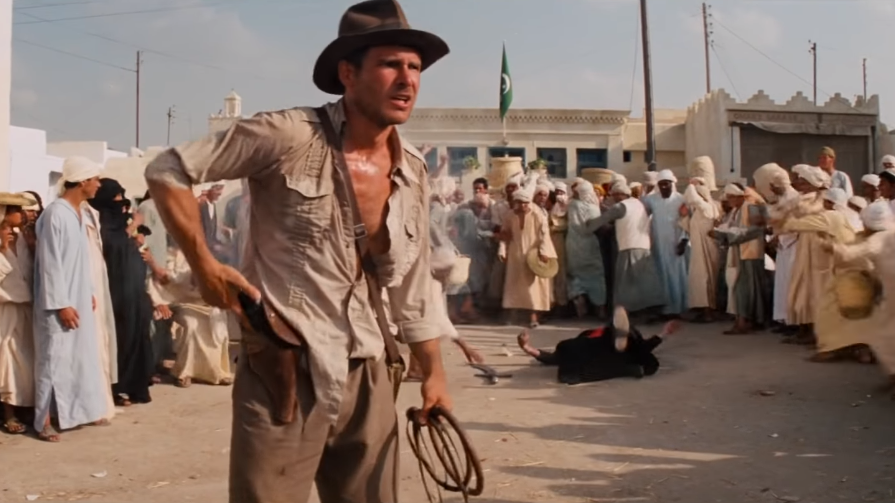
Short Answer: The famous “knife vs. gun” moment where Indiana Jones just shoots the swordsman instead of fighting was never in the original plan. Harrison Ford was really sick (dysentery), couldn’t do the long sword fight, pitched the idea to Spielberg, and that change turned into one of the funniest, most iconic moments in the movie.
The Fight That Never Happened
The plan was for an elaborate fight in a crowded Cairo marketplace: whip, wide sword, acrobatics, the works. The swordsman—stuntman Terry Richards—had trained for weeks, learning the choreography, practicing the weight of a big Arab sword, timing, stance, all of that. We know from several interviews and sources that Richards was fully prepared. :contentReference[oaicite:0]{index=0}
Ford Gets Sick, Ideas Get Real
While filming in Tunisia, Ford came down with dysentery. The heat, the conditions, combined with local food, I guess, did it. He was miserable. He later said he could barely leave his trailer without feeling like he was going to pass out. :contentReference[oaicite:1]{index=1} Because of that, the long fight seemed like too much—physically and logistically.
The Shot Heard Around Movie Fans
So Ford says: “What if I just pull my gun and shoot the guy?” Spielberg laughs, likes it, they go for it. The crew wasn’t all told ahead of time. When the swordsman starts his big flashy move, Jones just draws the revolver and shoots. Boom. The tension of setup + the absurdity of the payoff = pure gold. Watching it, you feel that shift: from expectation to “oh, he totally cheated, and it’s perfect.”
Why It Hits So Hard
This moment works because it encapsulates Indiana Jones: resourceful, pragmatic, not above using what’s easiest rather than what’s “honorable.” Plus, it’s funny. Audiences love a twist, and this twist was organic—it came out of necessity, not from “let’s be quirky.” The fact that it came from Ford being ill just adds to the legend. Also, credit to Terry Richards—he still gets to look cool in his entrance, even though the fight never happens. Their facial expressions, timing, all of that is on point.
Fan Reactions & Legacy
People talk about this scene all the time. Odds are, if someone names *Raiders*, they’ll mention “the swordsman” and how funny it is that Indy just shoots him. It’s in tons of lists of “best movie improv,” “funniest hero moments,” etc. Some trivia books say it was tested both ways (fight vs. gun) with audiences. Whether that’s fully confirmed or not is up for debate. But either way, the gun version stuck. It’s short, sharp, memorable.
Embed: Watch the Scene
Fun side note: Terry Richards (the swordsman) was a veteran stuntman. He reportedly was disappointed about losing the big fight, but he also thought the final version was hilarious and lasting. In interviews he said, “At least I’m super memorable now.”
🐍 Snakes. Why Did It Have to Be Snakes?
Short Answer: In the Well of Souls, Harrison Ford really did face a deadly king cobra. His only protection was a pane of glass so clean it was invisible on film. At one point, the cobra spat venom that hit the barrier—proving just how real the danger was.
Building the Well of Souls
The Well of Souls is one of those sets that just sears itself into your brain: the Ark hidden away underground, torches flickering, walls covered in hieroglyphics. Spielberg wanted the atmosphere to feel oppressive and terrifying, not just visually but emotionally. And nothing makes people squirm quite like snakes. Tons of snakes. Literally thousands of them.
The production team originally thought a few hundred snakes would do the trick. Wrong. When they let them loose on set, it looked sparse—more like a petting zoo than a nightmare pit. So they gathered more, calling in every handler they could find in England and shipping them to Elstree Studios. In the end, they wrangled around 6,000 snakes. Karen Allen (Marion) admitted that when she first stepped on set, her stomach dropped. “It was like a writhing carpet.”
The Cobra Face-Off
The single most iconic shot of this sequence is Indy staring down a huge king cobra. And yes—it was 100% real. The handlers placed the cobra in position, and Ford crouched opposite, revolver drawn. To keep him alive, the effects team set up a sheet of plexiglass between Ford and the snake. The glass was cleaned so well it was invisible to the camera. Audiences never saw it, but it was there, silently saving Harrison Ford’s life.
The tension gets dialed up when the cobra rears back and spits venom. On film it just looks menacing, but behind the scenes, the venom actually hit the glass and dripped down. If not for that barrier, Ford would’ve been in serious danger. That’s not acting you see on his face—that’s genuine adrenaline. Ford later admitted he’s not exactly a snake lover, which only added to the realism.
Other Snake Troubles
The cobra wasn’t the only issue. Some of the other snakes were just as deadly. Spielberg said he had nightmares about what might happen if one of the cobras or vipers got loose. To bulk up the numbers, the crew even tossed in fake snakes—garden hoses painted and cut to move under wires. Funny thing is, when you rewatch, you can totally spot a few if you look carefully. But honestly, in the chaos, most audiences never notice.
Karen Allen vs. the Pythons
Karen Allen had her own snake struggles. In one shot, a large python slithers across her shoulders. Spielberg told her it was harmless, but Allen later admitted she was terrified. She held her scream until the cameras stopped rolling. Imagine doing take after take with a 20-foot snake crawling on you. That’s commitment.
The Fan Legacy
“Snakes. Why did it have to be snakes?” has become one of Indy’s most famous lines. It’s funny because it feels human—this big, tough adventurer isn’t scared of bullets or Nazis, but snakes make his skin crawl. That moment, paired with the cobra stare-down, created one of the most memorable phobias in movie history. Decades later, people still shout that line when they see a garden snake in their backyard.
Embed: Watch the Cobra Scene
Fun side note: If you freeze-frame the wide shots, you can see a cheeky Easter egg—carved hieroglyphs of R2-D2 and C-3PO on one of the walls. Spielberg and Lucas couldn’t resist slipping in a nod to Star Wars. It’s a blink-and-you-miss-it detail, but fans still go hunting for it.
🌵 The Tunisia Plague: When Raiders Became Survivor: Hollywood Edition
Short Answer: While filming in Tunisia, nearly the entire cast and crew came down with brutal dysentery. The only major player who avoided it? Steven Spielberg, who brought his own stash of Spaghettios and bottled water from the U.S. The sickness shaped how the movie was shot—and gave us some of Indy’s best moments.
Heat, Sand, and Sickness
Spielberg and Lucas picked Tunisia for its sun-baked deserts, exotic marketplaces, and ancient ruins—perfect for bringing 1930s adventure serials to life. What they didn’t count on was how miserable filming there would be. Temperatures soared past 100°F. The food and water weren’t safe for Western stomachs. Within days, the crew started dropping. Actors, stuntmen, even key camera operators were sidelined by dysentery. Karen Allen (Marion Ravenwood) later said she could barely leave her tent without being doubled over in pain.
The worst part? They were in the middle of complex action scenes—market chases, fights, explosions—and suddenly half the people needed a bathroom break. It turned the shoot into a logistical nightmare.
Ford’s Ordeal
No one got hit harder than Harrison Ford. The swordsman scene wasn’t the only thing shortened because of his illness. He was running on fumes most of the Tunisia shoot, losing weight fast and often collapsing between takes. Ford admitted later that he had no idea how he pulled through, other than sheer stubbornness. “I was no longer capable of staying out of my trailer for more than it took to expose a roll of film,” he said in one Q&A. When you watch his drained, sweaty performance in those desert scenes—it’s not just acting. The guy was legitimately suffering.
Spielberg’s Secret Stash
Then there was Spielberg. The director avoided the plague by refusing to eat or drink anything local. Instead, he packed crates of bottled water and canned food from home. His go-to meal? Spaghettios. While everyone else was rushing for the bathrooms, Spielberg was sitting pretty, spoon in hand. Some crew members joked that he was the healthiest man in Tunisia.
That little bit of foresight might have saved the movie. If Spielberg had gone down too, production could have collapsed. Instead, he stayed on his feet and kept the shoot moving, even as everyone else was struggling.
How the Illness Shaped the Film
In a strange way, the dysentery outbreak helped *Raiders*. Because Ford and others couldn’t physically endure long, elaborate shoots, Spielberg had to find faster, more creative solutions. That’s how we got the legendary swordsman gag—but also the film’s overall pace. Spielberg later admitted he shot faster than usual, often wrapping in one or two takes. That efficiency gave *Raiders* its snappy, pulpy energy. Instead of bloated action scenes, you get quick, punchy moments that feel true to the spirit of the old Saturday serials.
Embed: Watch the Boulder Chase (YouTube Short)
Fans Still Talk About It
Among film fans, the Tunisia dysentery saga is legendary. It’s not just trivia—it explains why some of the movie’s most beloved moments exist. The swordsman scene, the slightly weary look in Ford’s eyes, the quick pacing of desert sequences—they’re all partly because the cast and crew were trying to survive long enough to finish the movie. It’s the kind of behind-the-scenes chaos that gives *Raiders* its authentic grit. Indy was fighting to survive onscreen, and the people making the film were doing the same offscreen.
Fun side note: Tunisia was also where George Lucas had filmed much of *Star Wars: A New Hope* a few years earlier. So for Lucas, it was déjà vu: same desert, same chaos, different heroes. Apparently, Tatooine and Indy’s deserts shared the same stomach-churning curse.
🪨 The Boulder Chase: Harrison Ford vs. a 12-Foot Rock
Short Answer: The massive boulder in the opening wasn’t special effects—it was a real 12-foot fiberglass prop that rolled straight at Harrison Ford. He insisted on doing the stunt himself, sprinting in front of it ten times while Spielberg filmed from different angles. It became one of the most iconic opening scenes in cinema.
Building the Boulder
When Spielberg and Lucas dreamed up the opening temple escape, they wanted to set the tone right away: Indiana Jones wasn’t just clever—he survived by the skin of his teeth. The art department, led by production designer Norman Reynolds, constructed a giant boulder from fiberglass and plaster. It stood about 12 feet high, weighed a few hundred pounds, and ran on carefully built tracks so it could roll smoothly but still look menacing on camera.
Spielberg admitted later that he wanted the sequence to be over-the-top but grounded. “You know it’s crazy,” he said, “but it also feels like something Indy might actually have to run from.”
Ford’s Decision: No Stuntman
Harrison Ford was never shy about doing his own stunts, but this one was risky. If he tripped, the fiberglass boulder could seriously injure him. Spielberg suggested letting a stuntman take over. Ford refused. He argued that the audience needed to see Indy’s panic up close to believe the danger. So he ran it himself—again and again. In total, Ford sprinted in front of that rolling monster at least ten times while Spielberg captured different angles. The final cut stitches them together to make the boulder’s chase feel endless.
What Could Have Gone Wrong
The floor was slick, the set narrow, and the timing had to be exact. A misstep could’ve crushed Ford against the temple walls. Even though the boulder was lighter than it looked, it was still heavy enough to hurt. Watching the scene today, you can see genuine fear in Ford’s eyes. That’s not acting—it’s survival instinct kicking in. Spielberg later said that the real risk is exactly what made the scene work.
The Opening That Hooked Audiences
Spielberg wanted the movie to grab audiences right away—no slow build, just instant adrenaline. The boulder chase delivered. It told you everything you needed to know about Indy in a few minutes: he’s brave, resourceful, but always one step from disaster. By the time Indy dives out of the cave and runs smack into Belloq and the Hovito warriors, the audience is hooked. You don’t need exposition—you’ve already lived through an adventure with him.
Embed: Watch the Boulder Chase
Legacy of the Boulder
The sequence is so famous it’s been parodied and referenced endlessly—in The Simpsons, Family Guy, video games, and even theme park rides. It’s the kind of scene that instantly tells you what movie it came from. Decades later, fans still point to it as one of the best openings in movie history. And the fact that Ford himself risked it makes it even cooler. No CGI, no green screen—just a guy, a whip, and a giant rock barreling toward him.
Fun side note: The original fiberglass boulder prop still exists. It’s been displayed in multiple museum exhibits, and fans line up to take selfies with it. Standing next to it, you realize just how insane Ford was to actually run in front of it.
🔥 The Melting Nazis: Practical Effects at Their Goriest
Short Answer: The gruesome scene where Nazi villains’ faces melt and explode was done entirely with practical effects. The effects team built wax and gelatin head casts, heated them with industrial-strength heat lamps and blowtorches, and filmed the process in time-lapse. What you see is real wax and rubber melting—no CGI at all.
Why the Scene Existed
The climax of *Raiders of the Lost Ark* had to be unforgettable. The Ark of the Covenant wasn’t just a MacGuffin—it was meant to show divine power. Spielberg wanted the Nazis’ greed punished in a spectacular, terrifying way. His solution: biblical wrath as old-school horror. This was the moment the movie shifted from pulp adventure into something darker, with imagery right out of a nightmare.
The Effects Team’s Challenge
Enter Chris Walas and his special effects crew. CGI wasn’t an option in 1981, so they had to go practical. They created life-sized busts of Ronald Lacey (Major Toht) and other villains. Each bust was built in layers: wax and gelatin for skin, latex for muscle, colored gelatin for blood and fat, and plaster for bone. They painted each layer so when the heat hit, it melted in sequence—skin first, then muscle, then bone. It was science and art combined.
The busts were placed in front of heat lamps and industrial-strength blow dryers. The crew filmed the melts in real time over minutes, sometimes hours, then sped it up in post-production. The result: horrifyingly realistic face-melting at just the right pace.
The Fire and the Explosion
For Dietrich’s death, they added a collapsing, imploding effect, sucking in the latex to make it look like his head shriveled. For Belloq (Paul Freeman), the finale, they went all in with a head explosion. To achieve it, the crew packed Freeman’s cast with meat, fruit, and other organic gunk, then detonated it with compressed air. Spielberg thought it was hilarious and disgusting at the same time. He loved it, but the MPAA ratings board didn’t.
The MPAA Problem
The original cut was so gory the MPAA threatened to slap the film with an R rating. Spielberg needed *Raiders* to be PG to reach family audiences. His solution? Add a wall of flames in front of the head explosion to obscure some of the detail. That quick effect saved the rating, but fans who’ve seen the raw footage say the uncut version is even nastier.
Embed: Watch the Melting Nazis Scene
Audience Reaction
When audiences first saw the scene in 1981, it blew their minds. Kids in theaters reportedly screamed and hid their eyes. Parents complained it was too graphic for a PG movie. But that controversy just fueled the movie’s legend. To this day, people cite the melting Nazis as one of the most shocking special effects ever pulled off in a mainstream blockbuster.
Legacy
What makes the effect so enduring is that it was all practical. No CGI sheen, no digital shortcuts—just makeup, wax, and clever filmmaking. Even modern audiences, raised on computer effects, still find it gross and convincing. Spielberg himself said it was one of his favorite gags in the film. And for fans, it’s the moment when *Raiders* goes from adventure movie to horror movie in the blink of an eye.
Fun side note: Ronald Lacey, who played Toht, reportedly loved watching his wax doppelgänger melt. He thought it was the ultimate way for a villain to go out—burned into pop culture forever.
🐒 The Monkey Who Saluted Hitler (Thanks to Grapes)
Short Answer: The monkey that gives a Nazi salute in *Raiders* didn’t do it out of ideology—he did it for grapes. After dozens of takes, the trainer finally coaxed the animal into raising his paw high enough to pass as a “Sieg Heil.” The moment is so strange it became one of the most infamous animal gags in movie history.
A Villainous Sidekick
In the Cairo marketplace sequence, Indy and Marion are unknowingly followed by a pet monkey owned by a Nazi sympathizer. The monkey spies on them, screeches at key moments, and even leads the villains to their location. To emphasize the monkey’s sinister allegiance, Spielberg wanted a shot of the animal literally giving a Nazi salute. It was absurd, unsettling, and darkly funny—a perfect fit for the pulpy, heightened tone of the movie.
How Do You Train a Monkey to Salute?
The problem was obvious: how do you get a capuchin monkey to perform a human gesture on command? Animal trainers on set experimented with different methods, from hand signals to noises. Nothing worked. Finally, the solution turned out to be the oldest trick in the book—bribery. The trainer dangled grapes just out of reach, holding them above the monkey’s head. Naturally, the monkey reached upward, stretching his arm into the air. With the right camera angle, it looked exactly like a stiff-armed Nazi salute.
Even then, it wasn’t easy. The monkey did it inconsistently, distracted by the chaos of the set. Spielberg reportedly burned through take after take, waiting for the one perfect shot where the monkey’s paw was raised high and still long enough to pass as intentional. After dozens of attempts, they finally nailed it.
The salute is so brief you could almost miss it, but it lands like a gut punch. Suddenly, this seemingly cute little animal is siding with the villains in the most shocking way. It’s a moment that makes audiences gasp, laugh, or just mutter, “Did that monkey really just salute Hitler?” It adds a surreal edge to the story and reminds you that in Spielberg’s world, even animals can pick sides.
Audience Reaction
The salute got the reaction Spielberg wanted: disbelief mixed with nervous laughter. Some viewers found it hilarious, others unsettling, but everyone remembered it. It’s one of those blink-and-you’ll-miss-it gags that fans love pointing out to first-time viewers. Over the years, it’s become a staple in movie trivia lists and “did you know?” articles about *Raiders.*
The Monkey’s Dark Fate
In the story, the monkey eventually eats poisoned dates intended for Indy and dies. It’s one of the film’s darker turns, a reminder that loyalty to the wrong side doesn’t end well. Spielberg used the monkey almost like a cartoon villain’s sidekick—comic relief with a sinister edge. When the monkey dies, the audience doesn’t mourn; they nod grimly. It was siding with Nazis, after all.
Legacy of the Saluting Monkey
Decades later, fans still bring up the saluting monkey as one of the strangest touches in an already chaotic movie. It’s the kind of gag only Spielberg could get away with: part comedy, part shock, and completely unforgettable. In fan discussions, you’ll hear people debate whether it was genius or too bizarre—but either way, everyone remembers it.
Fun side note: The monkey’s trainer said the animal was more interested in grapes than politics, but Spielberg swore the final shot was “one of the greatest bits of acting I’ve ever seen from a monkey.”
🚚 Harrison Ford’s Death-Defying Truck Chase Stunt
Short Answer: Harrison Ford insisted on doing the majority of his own stunts in Raiders of the Lost Ark, including the truck chase sequence. In one of the most dangerous shots, he was dragged behind a moving truck and crawled underneath it — a stunt that could have killed him had anything gone wrong.
The Origins of the Stunt
For the truck chase, Spielberg wanted an homage to classic Westerns where heroes are dragged by horses. Stunt coordinator Terry Leonard designed the sequence with careful precision: Ford’s Indiana Jones is shot in the arm, thrown against the grille of a truck, dragged under it, and then climbs back up. Leonard performed the master stunt once, and the footage was perfect. But Ford, ever determined to sell the authenticity of Indy, convinced Spielberg to let him do it himself.
Ford’s Commitment to Realism
Harrison Ford’s attitude was simple: if audiences could tell it was a stuntman, the illusion would break. He trained with Leonard and rehearsed sliding beneath the vehicle, knowing a single mistake could end with serious injury. The truck was custom-rigged with a trench beneath to give Ford space, but the margin for error was razor thin.
The Payoff
Spielberg later admitted that letting Ford do the stunt gave the scene unmatched tension. Viewers see the real Indiana Jones — not a double — fighting for survival. It became one of the most talked-about action sequences of the 1980s and set a new standard for blockbuster realism.
Legacy of the Scene
The truck chase remains one of the crown jewels of practical stunt work. Ford’s grit blurred the line between actor and action hero, cementing Indiana Jones as a believable character rather than a comic-book caricature. It also showed that sometimes danger and authenticity are what make a movie timeless.
Learn how Harrison Ford completed the whole scene and injuring himself by getting run over by a plane at …go behind the making of the Raiders of the Lost Ark truck chase stunt—how Ford did it, who doubled him, and how the under-truck drag worked.
Embed: Watch the Scene
🕷️ Kate Capshaw’s Real Fear of Bugs and Snakes
Short Answer: Kate Capshaw, who played Willie Scott in Temple of Doom, had a genuine phobia of creepy-crawlies. When filming the infamous bug chamber sequence, her screams weren’t acting — they were real.
The Bug Chamber Nightmare
One of the most memorable scenes in Temple of Doom sees Willie trapped in a chamber filled with thousands of insects while Indy and Short Round face deadly spikes. Capshaw had made it clear to Spielberg that she was terrified of bugs and snakes. Spielberg reassured her, but when the cameras rolled, she was covered with giant stick insects, beetles, and creepy crawlies.
Capshaw’s Bravery
Capshaw reportedly downed a glass of wine before filming to calm her nerves. She endured multiple takes where live insects crawled into her hair and clothes. At one point, handlers had to remove beetles that burrowed into her costume. Her shrieks of disgust, which might sound over-the-top to viewers, were in fact completely authentic.
The Snake Scene Connection
Although the bug chamber gets most of the attention, Capshaw also had to confront her fear of snakes during the underground temple scenes. Between Ford’s whip cracks and Ke Huy Quan’s quick wit as Short Round, Capshaw provided comic relief — but underneath, she was genuinely fighting panic.
Why It Works
The authenticity of her reactions gave the film raw comic energy. Willie Scott may be a “damsel in distress,” but her genuine revulsion in the bug chamber is one of the most memorable sequences in the series. Spielberg later admitted that Capshaw’s courage helped elevate the sequence, turning what could have been camp into unforgettable movie magic.
Embed: Watch the Short
👨👦 Sean Connery & Harrison Ford’s Improvised Banter
Short Answer: Much of the sparkling chemistry between Harrison Ford and Sean Connery in The Last Crusade came from improvised banter. The actors ad-libbed several lines, including the legendary “She talks in her sleep” joke.
Father and Son On and Off Screen
Spielberg encouraged Connery and Ford to treat their scenes like a father-son comedy act. Connery, fresh off a career of suave James Bond roles, leaned into playing Indy’s scholarly but eccentric dad. Ford, meanwhile, responded in kind, treating Connery’s improvisations with genuine amusement.
The “She Talks in Her Sleep” Line
One of the film’s most memorable laughs occurs when Elsa, the female lead, is revealed to have seduced both father and son. Connery improvised the cheeky line “She talks in her sleep,” catching Ford completely off guard. The laugh Ford gives in the scene is real, not scripted.
Why It Resonates
The banter between Ford and Connery elevated The Last Crusade beyond typical action fare. Their improvisations gave warmth and humanity to a blockbuster that could have been all spectacle. Instead, audiences left theaters quoting their exchanges as much as they remembered the tank battle or grail finale.
A Legendary Duo
The Connery-Ford pairing is still remembered as one of the greatest father-son duos in film history. Spielberg himself said their natural riffing was “pure lightning in a bottle.” It’s proof that sometimes the best scriptwriting comes from letting legends play.
Embed: Watch Harrison Ford & Sean Connery Talk About Their Work Together
💥 Harrison Ford’s Serious Back Injury During Temple of Doom
Short Answer: While filming Temple of Doom in Sri Lanka, Harrison Ford suffered a severe back injury that required surgery and temporarily halted production.
The Injury
During one of the film’s demanding action sequences, Ford aggravated his back performing stunts. The injury was serious enough that doctors recommended immediate treatment. Ford flew back to Los Angeles, leaving Spielberg and the crew with a dilemma: pause production or find workarounds.
Stunt Doubles Step In
While Ford was recovering, stunt doubles performed the majority of Indy’s action scenes, including much of the famous rope bridge finale. Spielberg shot wide angles and back-turned shots to conceal the doubles, then saved Ford’s close-ups for when he returned post-surgery.
How It Impacted the Film
Remarkably, audiences never noticed the substitution. Spielberg’s editing and Ford’s later inserts stitched the sequences together seamlessly. The fact that Temple of Doom looks so cohesive despite its leading man being absent for weeks is a testament to the crew’s resourcefulness.
Legacy
Ford’s injury is often cited as proof of the physical toll Indiana Jones took on him. Between Raiders’ stunts, Temple’s back surgery, and later shoulder issues, Ford literally sacrificed his body for Indy. It’s part of why fans view him as a true action star, not just an actor playing one.
🌴 Shia LaBeouf’s Infamous Monkey Vine-Swing Scene
Short Answer: In Kingdom of the Crystal Skull, Shia LaBeouf’s character Mutt Williams swings through the jungle with a pack of CGI monkeys. The scene has become one of the most controversial moments in the franchise, often cited as a low point.
The Idea Behind the Scene
George Lucas reportedly pushed for a pulpy, comic-book vibe in Crystal Skull. The monkey vine swing was intended as a fun homage to old adventure serials. Unfortunately, the CGI effects clashed with fans’ expectations of practical stunts, making the sequence look cartoonish compared to earlier Indy films.
LaBeouf’s Regret
Shia LaBeouf later admitted in interviews that he was embarrassed by the scene, saying it damaged his credibility and the film’s reputation. He even suggested Spielberg and Lucas made creative choices that didn’t land with audiences, which caused tension behind the scenes.
Fan Backlash
When the film premiered in 2008, critics and fans immediately singled out the vine swing as one of the weakest moments. While the fridge-nuke opening sparked debate, the monkeys swinging in CGI vines became meme fodder. Even die-hard fans struggled to defend it.
Legacy
Despite the negativity, the vine-swing scene is now infamous enough to be part of Indy’s cultural footprint. It serves as a reminder of how delicate the balance is between pulp fun and believability. Compared to Ford’s practical stunts in the earlier films, the CGI monkeys highlight why the original trilogy remains beloved for its grit and realism.
Embed: Watch the Scene
Final Take: Why Raiders’ Behind-the-Scenes Stories Are Legendary
The takeaway: The making of Raiders of the Lost Ark was just as thrilling—and sometimes as dangerous—as the story Indiana Jones lived through on screen. From Harrison Ford’s dysentery creating the legendary Cairo swordsman scene to the cobra separated only by glass, from the Tunisian plague to the rolling boulder chase, every behind-the-scenes fact feels like an adventure in itself.
These production stories are part of why the film endures. When fans talk about Indiana Jones trivia, they don’t just list plot points—they dive into these wild on-set tales. The saluting monkey bribed with grapes, the melting Nazi heads built from wax and gelatin, Ford sprinting for his life in front of a giant fiberglass boulder—these are the details that keep behind-the-scenes Raiders of the Lost Ark facts circulating decades later.
What makes them so powerful is that they weren’t planned marketing stunts. They were accidents, improvisations, and real struggles faced by a cast and crew determined to finish a movie against insane odds. That authenticity bleeds through the screen. You feel the danger, the heat, the chaos—and that’s why audiences still connect with the film over forty years later.
Raiders of the Lost Ark isn’t just one of the greatest adventure films ever made. It’s also one of the greatest examples of how movie magic is born from unpredictability. The stories behind the camera are as legendary as Indy’s whip and fedora, ensuring that this film’s legacy will never fade from cinema history.
The Making of Raiders of the Lost Ark: How Chaos Created a Classic
Short Answer: Raiders of the Lost Ark wasn’t a sure thing in 1981. It started as a conversation between Steven Spielberg and George Lucas, was budgeted for less than $20 million, and carried modest expectations. But through lucky casting choices, bold direction, and a crew that survived brutal conditions, it became one of the most successful adventure films of all time.
The Spark: Spielberg Meets Lucas in Hawaii
In the summer of 1977, while Star Wars was smashing box office records, George Lucas took a vacation in Hawaii with his friend Steven Spielberg. Spielberg confessed he wanted to direct a James Bond movie. Lucas countered with something he’d been toying with since the early 1970s: an adventure hero inspired by the pulp serials of the ’30s and ’40s. “I’ve got something better than Bond,” Lucas told him. That seed became Indiana Jones.
Lucas envisioned a globe-trotting archaeologist who could be charming one moment and bloodied the next, an everyman hero who wasn’t invincible. Spielberg loved the idea instantly. Together, they started sketching out what would become Raiders of the Lost Ark.
The Writing: From Lawrence Kasdan to Indy’s DNA
Lucas brought in Lawrence Kasdan, fresh off scripting The Empire Strikes Back, to turn the concept into a screenplay. Frank Marshall and Kathleen Kennedy joined as producers, forming what would later become Amblin Entertainment. They brainstormed action set pieces first—giant boulders, Nazi villains, exotic temples—and then stitched a story around them. The Ark of the Covenant became the central artifact, a mix of biblical mythology and pulp spectacle.
Indy’s look—leather jacket, fedora, and bullwhip—was deliberately designed to feel iconic, like Superman’s cape or Batman’s cowl. Costume designer Deborah Nadoolman aged the clothes by hand, even running the jacket over with a truck to give it that “lived-in” feel.
Cast of Destiny: Harrison Ford Almost Didn’t Get the Role
Indiana Jones was almost played by Tom Selleck. Spielberg always wanted Harrison Ford, but Lucas hesitated—Ford was already Han Solo, and Lucas worried about overexposing him. Selleck actually won the role, but CBS locked him into his Magnum, P.I. contract, forcing him to drop out. At the last moment, Ford got the call. That twist of fate gave us one of the most iconic pairings of actor and character in movie history. Karen Allen was cast as Marion Ravenwood, bringing grit and warmth to Indy’s counterpart.
Production: Fast, Cheap, and Out of Control
Paramount Pictures agreed to finance the film, but only if Spielberg promised to keep it on budget. After his previous movie, 1941, had gone wildly over cost, Spielberg had to prove he could shoot fast. The budget was set at about $18 million—modest even for the time. Spielberg ended up averaging six pages of script per day, an incredible pace for an action film. He shot with minimal takes, sometimes printing the very first attempt.
Filming stretched across the globe: England, Hawaii, Tunisia, and California. Tunisia, in particular, was a nightmare. The heat was brutal, and almost the entire crew came down with dysentery. Spielberg famously avoided it by eating nothing but canned Spaghettios he’d packed himself. Harrison Ford wasn’t so lucky, but his illness gave us the improvised swordsman scene—a moment that became movie legend.
Box Office and Worldwide Success
*Raiders of the Lost Ark* premiered on June 12, 1981. Paramount expected a hit but nothing earth-shattering. Instead, it exploded. The movie grossed over $212 million in the U.S. and more than $389 million worldwide, making it the highest-grossing film of 1981. On a budget under $20 million, that return was staggering. Critical acclaim followed, with the film earning nine Academy Award nominations and winning five, including Best Editing, Best Sound, and Best Visual Effects.
The movie didn’t just succeed—it redefined blockbuster filmmaking. It proved audiences wanted adventure stories that were both thrilling and funny, that could scare you one minute and make you laugh the next. It also launched a franchise: three sequels (so far), a TV series, video games, theme park rides, and endless homages.
Why We Were Lucky
Looking back, it’s shocking how many things could have gone wrong. If Tom Selleck hadn’t been tied up, Harrison Ford wouldn’t have been Indy. If Spielberg hadn’t proven he could keep things on schedule, the studio might have pulled the plug. If Ford’s dysentery hadn’t forced a script change, we’d have lost one of the most iconic gags in movie history. The chaos and improvisation that plagued the production are exactly what gave the film its gritty, lived-in feel.
Sometimes the stars align in ways nobody expects. *Raiders of the Lost Ark* was born from a vacation chat, survived food poisoning, budget pressure, and brutal shoots, and came out the other side as a masterpiece. Audiences were lucky it all came together. Cinema itself was lucky—because it gave us Indiana Jones.
Legacy: Four decades later, Raiders still holds up as one of the greatest adventure films ever made. Its mix of pulp thrills, humor, and danger remains unmatched. And its behind-the-scenes story is a reminder that sometimes chaos, desperation, and luck are the real ingredients of movie magic.
🏆 Awards & Achievements — Raiders of the Lost Ark (1981)
Academy Awards (Oscars)
- Won — Best Art Direction (Norman Reynolds, Leslie Dilley, Michael Ford)
- Won — Best Film Editing (Michael Kahn)
- Won — Best Sound (Bill Varney, Steve Maslow, Gregg Landaker, Roy Charman)
- Won — Best Sound Effects Editing (Ben Burtt, Richard L. Anderson)
- Won — Best Visual Effects (Richard Edlund, Kit West, Bruce Nicholson, Joe Johnston)
- Nominated — Best Picture
- Nominated — Best Director (Steven Spielberg)
- Nominated — Best Cinematography (Douglas Slocombe)
- Nominated — Best Original Score (John Williams)
BAFTA Awards
- Won — Best Production Design/Art Direction (Norman Reynolds)
- Nominated — Best Film
- Nominated — Best Direction (Steven Spielberg)
- Nominated — Best Editing (Michael Kahn)
- Nominated — Best Sound
- Nominated — Best Score (John Williams)
Golden Globe Awards
- Nominated — Best Motion Picture: Drama
- Nominated — Best Director (Steven Spielberg)
- Nominated — Best Original Score (John Williams)
Other Recognition
- Hugo Award Winner (1982) — Best Dramatic Presentation
- Saturn Awards Winner — Best Fantasy Film, Best Director, Best Actor (Harrison Ford)
- National Film Registry — Selected by the Library of Congress in 1999 as “culturally, historically, or aesthetically significant.”
Box Office Milestone
- Worldwide Gross: $389.9 million — On an $18 million budget, it became the highest-grossing film of 1981.
- U.S. Gross: $212 million — Stayed in theaters for over a year, dominating box offices worldwide.
Pop Culture Legacy
- Ranked by AFI — #2 on AFI’s “Top 10 Fantasy Films” and #60 on “100 Years, 100 Movies.”
- Iconic Character — Indiana Jones ranked #2 on AFI’s list of greatest film heroes, second only to Atticus Finch.
- Influence — Inspired countless homages in TV, video games, and theme park rides, including the famous Indiana Jones Adventure at Disneyland.
Fan Recognition
- Raiders of the Lost Ark isn’t just award-winning—it’s universally regarded as one of the greatest adventure films ever made, blending pulp serial thrills with blockbuster spectacle. Over forty years later, it’s still a touchstone for action filmmaking.
🌍 Philanthropy & Community Impact — Raiders of the Lost Ark
While Raiders of the Lost Ark (1981) itself was produced as a big-screen adventure film with no formal charity tie-ins, the film’s legacy, and the philanthropic work of its creators, has had a ripple effect on communities, film preservation, and global causes.
Spielberg & Lucas Foundations
- Steven Spielberg founded the Shoah Foundation in 1994, dedicated to preserving Holocaust survivor testimonies—resonating deeply given Raiders’ Nazi villain themes.
- George Lucas established Lucasfilm Foundation and has donated billions to education initiatives, including the George Lucas Educational Foundation (Edutopia).
- Both directors have leveraged the success of franchises like Indiana Jones to fuel philanthropic projects in education, film preservation, and human rights.
Harrison Ford’s Advocacy
- Outside the screen, Harrison Ford has been a long-time environmental advocate. He has served as vice-chair of Conservation International, lending his Indiana Jones fame to campaigns protecting forests and wildlife.
- Ford’s work often draws on his Raiders persona, reminding audiences that real-world treasures—like rainforests—are worth saving more than fictional Arks.
Community Impact of the Franchise
- Tourism — Locations used in Raiders, such as Tunisia and Kauai, saw boosts in tourism, generating revenue and jobs for local communities.
- Theme Park Rides — The Indiana Jones Adventure rides at Disneyland and DisneySea not only extend the film’s cultural legacy but also raise millions annually for Disney’s charitable partnerships.
- Fan Events — Screenings, fan clubs, and trivia nights often tie into fundraising for local charities, especially around anniversaries of the film.
Film Preservation & Education
- The success of Raiders helped inspire Spielberg and Lucas to invest heavily in film preservation efforts, ensuring classic films would survive for future generations.
- Universities and film schools often use Raiders in curricula, supported by grants from the Lucas Educational Foundation, connecting blockbuster filmmaking to academic study and student opportunities.
In short: Even though Raiders of the Lost Ark didn’t start as a philanthropic project, the people behind it—Spielberg, Lucas, Ford, and others—used its success to support education, humanitarian work, environmental conservation, and film preservation. The spirit of adventure continues to inspire real-world giving.
🔴 Indiana Jones & Raiders of the Lost Ark Trivia Quiz
1) Who directed Raiders of the Lost Ark (1981)?
- Steven Spielberg
- George Lucas
- Francis Ford Coppola
- Richard Donner
2) Which actor almost played Indiana Jones before Harrison Ford got the role?
- Kurt Russell
- Tom Selleck
- Nick Nolte
- Sam Neill
3) What was the budget for Raiders of the Lost Ark?
- $25 million
- $18 million
- $35 million
- $10 million
4) Worldwide, how much did Raiders of the Lost Ark gross during its initial run?
- $200 million
- $389 million
- $150 million
- $500 million
5) Which biblical artifact is Indiana Jones searching for in Raiders of the Lost Ark?
- Holy Grail
- Spear of Destiny
- Ark of the Covenant
- Shroud of Turin
6) What famous improvised scene came from Harrison Ford being sick with dysentery?
- The boulder chase
- Shooting the Cairo swordsman
- The truck chase
- The Well of Souls snake pit
7) What real-life food did Steven Spielberg live on to avoid dysentery in Tunisia?
- Campbell’s soup
- Spaghettios
- Canned chili
- Peanut butter sandwiches
8) What separates Harrison Ford from the cobra in the Well of Souls scene?
- A handler’s hook
- Snake repellent
- A pane of glass
- A fake snake
9) How many snakes were brought in to film the Well of Souls sequence?
- 1,000
- 3,000
- 6,000+
- 10,000+
10) What line does Indiana Jones famously say about his fear of snakes?
- “Snakes give me the creeps.”
- “Snakes. Why did it have to be snakes?”
- “I hate reptiles.”
- “Get that thing away from me.”
11) Which Nazi villain melts gruesomely at the end of Raiders?
- Major Toht
- Colonel Dietrich
- Belloq
- Arnold Ernst Vogel
12) How was the melting head effect created?
- Wax & gelatin models under heat lamps
- Claymation
- Computer animation
- Rear projection
13) Which composer created the legendary Indiana Jones theme?
- John Williams
- Jerry Goldsmith
- Alan Silvestri
- Hans Zimmer
14) What was the working title Lucas first gave the project?
- The Adventures of Indiana Smith
- The Lost Ark of Doom
- Temple of Death
- Treasure of the Covenant
15) Where was the boulder chase scene filmed?
- Elstree Studios (England)
- Tunisia
- Kauai
- Arizona
16) How many times did Harrison Ford run in front of the boulder for different takes?
- 5
- 10+
- 2
- 20+
17) What animal gives a Nazi salute in the film?
- A monkey
- A dog
- A parrot
- A camel
18) How was the monkey trained to salute?
- Clicker training
- Trainer held grapes above its head
- Sound cues
- Mechanical trick
19) Who plays Marion Ravenwood?
- Karen Allen
- Kate Capshaw
- Alison Doody
- Cate Blanchett
20) What year is Raiders of the Lost Ark set in?
- 1930
- 1934
- 1936
- 1939
21) What does Indy use to escape the truck chase?
- He slides under the truck with his whip
- He hides in barrels
- He jumps onto a horse
- He disguises himself as a soldier
22) Who composed the famous “Raiders March” theme?
- John Williams
- Howard Shore
- Danny Elfman
- Ennio Morricone
23) What was Spielberg’s fastest shooting pace on Raiders?
- 2 pages a day
- 6 pages a day
- 10 pages a day
- 1 page a day
24) In what year was Raiders of the Lost Ark released?
- 1981
- 1979
- 1983
- 1984
25) Which award did Raiders of the Lost Ark NOT win at the Oscars?
- Best Picture
- Best Visual Effects
- Best Editing
- Best Sound
📖 Raiders of the Lost Ark: Frequently Asked Questions
When was Raiders of the Lost Ark released?
Raiders of the Lost Ark premiered on June 12, 1981, quickly becoming the highest-grossing movie of that year.
Who directed and produced Raiders of the Lost Ark?
The movie was directed by Steven Spielberg and produced by George Lucas through Lucasfilm Ltd., with distribution by Paramount Pictures.
What was the film’s budget and worldwide box office gross?
The budget for Raiders of the Lost Ark was around $18 million. It went on to gross over $389 million worldwide, making it one of the most profitable adventure films in history.
Why did Harrison Ford shoot the Cairo swordsman instead of fighting him?
Ford was suffering from dysentery during filming in Tunisia and was too weak to perform the long fight sequence. He suggested simply shooting the swordsman, and Spielberg agreed. The unscripted gag became one of the most iconic Indiana Jones trivia facts ever.
How dangerous was the cobra scene in the Well of Souls?
In the famous cobra standoff, Harrison Ford was protected only by a pane of glass placed between him and the deadly king cobra. At one point, the snake spat venom onto the glass, proving just how real the danger was.
How many snakes were used for the Well of Souls sequence?
Over 6,000 live snakes were brought in, with hoses and fake reptiles added to bulk up the numbers. Karen Allen recalled it as a “carpet of writhing snakes” unlike anything she’d ever seen.
Did Harrison Ford really run in front of the rolling boulder?
Yes. Ford insisted on doing the boulder chase stunt himself, sprinting in front of a 12-foot fiberglass boulder at least ten times for different camera angles. Spielberg admitted the risk was real, but the authenticity made the scene unforgettable.
How were the Nazi face-melting effects created?
The gruesome melting heads were achieved with wax and gelatin busts placed under heat lamps and filmed in time-lapse. For Belloq’s head explosion, the effects team packed the cast with meat and gunk, then blew it up with compressed air.
How did they make the monkey perform a Nazi salute?
The trainer held grapes above the monkey’s head, coaxing it to reach upward. Spielberg filmed dozens of takes until the gesture resembled a Nazi salute. The bizarre moment became one of the strangest bits of Raiders of the Lost Ark behind the scenes trivia.
How many Academy Awards did Raiders of the Lost Ark win?
Raiders won 5 Oscars, including Best Art Direction, Best Film Editing, Best Sound, Best Sound Effects Editing, and Best Visual Effects. It was also nominated for Best Picture, Best Director, Best Cinematography, and Best Score.
Why is Raiders of the Lost Ark considered a classic?
Its mix of pulp adventure, practical stunts, John Williams’ score, and improvisation born out of real hardship created a one-of-a-kind film. Behind-the-scenes chaos, from dysentery to experimental effects, added authenticity that audiences could feel. Over 40 years later, it remains one of the greatest adventure movies of all time.
📚 Raiders of the Lost Ark Affiliate


![Raiders of the Lost Ark [4K UHD]](https://flipthemoviescript.com/wp-content/uploads/2025/09/91hKyO-NtuL._AC_UY218_.jpg)


📚 Raiders of the Lost Ark References (APA)
Educational & Fact-Checking
📄 Wikipedia contributors. (2025, August 25). Raiders of the Lost Ark. In Wikipedia. https://en.wikipedia.org/wiki/Raiders_of_the_Lost_Ark
📄 IMDb. (1981). Raiders of the Lost Ark (1981). https://www.imdb.com/title/tt0082971/
📄 American Film Institute. (2008). AFI’s 10 Top 10: Top 10 Fantasy Films. https://www.afi.com/afis-10-top-10/
Journalism & Profiles
📄 Empire. (2021, June 12). Raiders of the Lost Ark at 40: An oral history. https://www.empireonline.com/movies/features/raiders-of-the-lost-ark-oral-history/
📄 Variety. (2021, June 12). ‘Raiders of the Lost Ark’ at 40: Steven Spielberg and George Lucas’ adventure classic turns 40. https://variety.com/2021/film/news/raiders-of-the-lost-ark-40th-anniversary-1234992170/
📄 The Guardian. (2016, June 9). How Raiders of the Lost Ark changed cinema. https://www.theguardian.com/film/2016/jun/09/how-raiders-of-the-lost-ark-changed-cinema
📄 The New York Times. (1981, June 12). Raiders of the Lost Ark: Review by Vincent Canby. https://www.nytimes.com/1981/06/12/movies/raiders-of-the-lost-ark.html
📄 The Hollywood Reporter. (2021, June 11). Raiders of the Lost Ark at 40: Revisiting Spielberg’s masterpiece. https://www.hollywoodreporter.com/movies/movie-news/raiders-of-the-lost-ark-at-40-1234969692/
📄 Los Angeles Times. (2012, June 11). Steven Spielberg looks back at Raiders. https://www.latimes.com/entertainment/la-et-raiders-steven-spielberg
Behind the Scenes & Trivia
📄 Looper. (2021, December 11). The iconic role that made Harrison Ford physically ill. https://www.looper.com/704320/the-iconic-role-that-made-harrison-ford-physically-ill/
📄 ComicBook.com. (2023, July 27). Harrison Ford recalls weird way Spielberg avoided dysentery. https://comicbook.com/movies/news/harrison-ford-steven-spielberg-dysentery-raiders/
📄 Screen Rant. (2021, June 14). Indiana Jones: 20 wild behind-the-scenes facts. https://screenrant.com/indiana-jones-raiders-lost-ark-behind-the-scenes-facts/
📄 Den of Geek. (2016, June 9). Raiders of the Lost Ark: Secrets of the film’s production. https://www.denofgeek.com/movies/raiders-of-the-lost-ark-making-of/
📄 MovieViral. (2016, February 25). Indiana Jones and the birth of a classic scene. https://www.movieviral.com/2016/02/25/indiana-jones-and-the-birth-of-a-classic-scene-by-kevin-cravedi/
Interviews & Retrospectives
📄 Spielberg, S. (2016). Steven Spielberg on Raiders of the Lost Ark [Interview]. Empire. https://www.empireonline.com/movies/features/steven-spielberg-on-raiders/
📄 Boucher, G. (2011). Harrison Ford Q&A on Raiders. Los Angeles Times Hero Complex. https://herocomplex.latimes.com/movies/harrison-ford-on-raiders/
📄 Freeman, P. (2016). Paul Freeman remembers Belloq. The Guardian. https://www.theguardian.com/film/2016/jun/09/raiders-belloq-paul-freeman
📄 Allen, K. (2016). Karen Allen talks snakes and filming Raiders. Entertainment Weekly. https://ew.com/article/2016/06/10/karen-allen-raiders-of-the-lost-ark/
📄 Burtt, B. (2012). Creating the sound of Raiders. SoundWorks Collection. https://soundworkscollection.com/news/ben-burtt-sound-raiders
Love movie facts? Check out our ultimate guide for more!